U.S. Representatives Evan Jenkins, R-W.Va., and David McKinley, R-W.Va., have been outspoken in their support for the credits, she said.
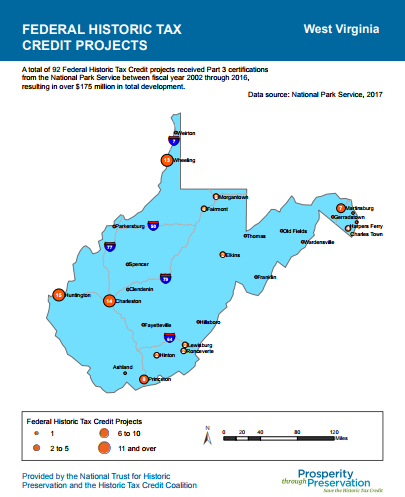
"We are grateful that McKinley and Jenkins requested the inclusion of this economic-development tool in the tax reform bill," LaPresta said. "Both legislators represent districts in which historic tax credits are attracting private investment." Historic tax credits helped finance 92 commercial-rehabilitation projects in West Virginia between 2002 and 2016, leveraging more than $175 million in development investment and supporting more than 3,500 construction jobs, she said. "These credits are highly influential when it comes to attracting larger businesses into West Virginia downtowns," LaPresta said. The tax credit was championed by President Ronald Reagan to encourage the rehabilitation of abandoned and underutilized properties. Since 1981, it has leveraged more than $131 billion in private investment and created more than 2.4 million, she said. The state Legislature in October increased the State Historic Tax Credit from 10 to 25 percent, but weakening or eliminating the Federal Historic Tax Credit could endanger the feasibility of nearly all historic rehabilitation projects in West Virginia. "We think the credit complements, rather than hinders, Congress's goal of pro-growth tax reform," LaPresta said. “There are a dozen buildings that we predicted would be rehabilitated with the increase of the state historic tax credit. Now, with the proposed elimination of the federal credit, we fear progress will be jeopardized." The Preservation Alliance of West Virginia is a non-profit dedicated to historic preservation and a statewide partner in the National Trust for Historic Preservation. LaPresta is urging business leaders who wish to advocate for the federal historic tax credit to contact the alliance at 304-345-6005 or visit its website at PAWV.org. MEDIA CONTACT Danielle LaPresta Executive Director Preservation Alliance of West Virginia www.pawv.org [email protected] 304-345-6005 This is not a drill! Last week the Republican Congressional leadership and the Administration released the Tax Reform Framework, which did NOT include the federal historic rehabilitation tax credit. The tax reform outline does, however, explicitly preserve business credits in two areas where leaders believe tax incentives have proven effective: research and development (R&D) and low-income housing. This suggests there is an opportunity for action. It’s remarkable how the historic tax credit has positively impacted community economies across West Virginia. Between 2002 and 2016 the historic rehabilitation tax credit has leveraged nearly $175 million in development, created over 3,500 jobs and brought in over $35 million in local, state and federal taxes. While the tax framework envisions repeal of all other business credits, including the historic rehabilitation tax credit, the outline gives discretion to the tax writing committees to decide to retain additional business credits to the extent budget limitations allow. Support for the federal historic rehabilitation tax credit is already gaining momentum in the House thanks to Rep. David McKinley (R - WV, 1). Rep. McKinley is circulating a Dear Colleague letter encouraging other Representatives to support the preservation of the federal historic rehabilitation tax credit. Now is the time to thank Rep. McKinley and ask Representatives Mooney and Jenkins to sign on with their West Virginia Colleague. Learn how below... THE TIME TO ACT IS NOW!The House Ways & Means Committee plans to produce a tax reform bill by the end of October and in the next three weeks it is imperative that you make your VOICE heard NOW! ACTION STEPS: CALL, WRITE, REPEATWrite an Email: The easiest way is to write your Congressman and Senator by sending them a message through their websites. You can use this form letter and cut and paste it into the message system on your Congressman's website (you may have to enter your zip code to authenticate that you are a constituent.) You can find each Representative and Senator's website and other contact information at the link below (for Representative McKinley - tell him thank you for his leadership in preserving the federal historic tax credit).
In your message, tell them the historic tax credit is important to your community and our state. If you have witnessed a preservation project in your community, tell them about it. The National Trust for Historic Preservation has good studies and statistics you can look at as well, but an example you know about is most powerful. Acknowledge that the need for tax reform is clear, but it must not come at the expense of this important economic redevelopment incentive, that more than pays for itself, and has a proven track record of creating jobs, revitalizing neighborhoods and saving historic buildings. To see your Representative and Senator's contact information click here. Call: Use your voice! Pick up the phone and call your congressman’s office and tell them why you support the historic tax credit. Tell them to remember you and your communities when they consider any tax reform. As a constituent your voice is important to your representative! Repeat: Have you emailed and called? Do it again. If you haven’t heard back from your congressman’s office within a few days, call and email again. Encourage your colleagues and fellow community members to do the same; write, call, repeat. The more voices we have telling congress just how impactful the historic tax credit is the better chance we have of getting included in tax reform. Please share your efforts with us and know that we are truly thankful for your efforts on behalf of the historic tax credit. If you have any questions or concerns please contact our office. Thank you! Preservation Alliance of West Virginia REPUBLICAN TAX REFORM FRAMEWORK RELEASED—HISTORIC TAX CREDIT NOT IDENTIFIED AS WORTH KEEPING!9/28/2017
Urge your Congressional delegation to contact members of the House Ways and Means and Senate Finance Committees with the message that repealing the historic tax credit is bad policy. The need for tax reform is clear, but it must not come at the expense of a program that more than pays for itself and has a proven track record of creating jobs, saving historic buildings, and revitalizing neighborhoods.
Now is the time to speak up for the historic tax credit. Join us in letting Washington know that historic preservation advocates need their voices heard. Our history is too important. Good news! On Thursday, February 16th, legislation was introduced in Congress that would make important changes to the historic tax credit. The bipartisan Historic Tax Credit Improvement Act (HTCIA)(H.R. 1158 / S.425) closely resembles legislation introduced in the last Congress that would improve access to the credit for smaller rehabilitation projects that will help revitalize our small towns and our inner cities.
The legislation was introduced in the House of Representatives by Congressmen Mike Kelly (R-PA) and Earl Blumenauer (D-OR) and is supported by 18 cosponsors, including nine Republicans and nine Democrats and eight members of the Ways and Means Committee. Senators Susan Collins (R-ME) and Ben Cardin (D-MD) introduced companion legislation in the Senate and were joined by Senators Cochran (R-MS), Gillibrand (D-NY), Leahy (D-VT), and Wicker (R-MS). The Historic Tax Credit Improvement Act encourages redevelopment of smaller, income-producing properties by:
Please contact your members of Congress and urge them to support the Historic Tax Credit Improvement Act,H.R. 1158 / S.425. Take Action The HTCIA provides Members of Congress with a way to indicate their support for the credit and offers several reform ideas that could be incorporated into a larger tax reform bill. Adding cosponsors to the legislation is a critical step to protecting the historic tax credit during the tax reform process. Urge Members of Congress to co-sponsor the Historic Tax Credit Improvement Act H.R. 1158 / S.425:
Contact district offices of both House and Senate Members and ask to schedule a meeting: To locate the name and phone number of your House Representative go to: http://www.house.gov/representatives/find/ To locate the names and phone number of your Senators go to: http://www.senate.gov/general/contact_information/senators_cfm.cfm?OrderBy=state&Sort=ASC Helpful Tips:
Resources:
o Shaw Sprague ([email protected]) o Renee Kuhlman ([email protected]) Thank you for speaking up in support of the federal historic tax credit! With your ongoing engagement, the historic tax credit will continue to revitalize our communities, stimulate the economy, and preserve our irreplaceable historic buildings. CALL TO ACTION: URGENT ADVOCACY NEEDED, HISTORIC TAX CREDIT IN DANGER OF REPEAL IN TAX REFORM12/12/2016
President-Elect Trump and Speaker Ryan have prioritized moving tax reform legislation in the first one hundred days of the next Congress which begins in January. A tax reform package could move quickly through Congress by way of the budget reconciliation process, which only requires a simple majority for passage in the Senate, instead of the typically needed 60 votes to cut off debate.
Ways and Means Republican Committee members will be meeting on December 14th-15th to agree on big picture elements of tax reform with a goal to have a draft bill to review in early January. We expect tax reform legislation will follow Speaker Ryan’s “A Better Way” blue print, released earlier this year. This document recommends eliminating tax credits and deductions, which would include the Historic Tax Credit (HTC), the New Markets Tax Credit (NMTC) and the Low Income Housing Tax Credit (LIHTC). The Historic Tax Credit is in grave danger of elimination in tax reform. Historic Tax Credit advocacy is urgently needed, both in the near term and throughout 2017. The Historic Tax Credit (HTC) is the most significant federal financial commitment to historic preservation. Over the last 36 years, the credit has created 2.3 million jobs, leveraged $117 billion in investment, and rehabilitated more than 41,250 buildings—all while generating enough in federal revenue to pay for itself. The Historic Tax Credit Coalition, National Trust for Historic Preservation, National Trust Community Investment Corporation and allied organizations, like the Preservation Alliance of WV, are moving quickly to increase lobbying capacity. However, there is no substitute for the advocacy that you can provide. Your assistance is critical! We are hopeful that if a sufficient number of Senators and Representatives convey their support for the HTC to party leadership and to members of the tax writing committees, the Historic Tax Credit can be retained as an important part of a reformed tax code. Requested Action: Contact House Members of Congress ASAP– Call (during office hours) or email the offices of your Members of Congress before December 14th and ask to speak to tax staff or staff contacts you have in offices. Since there are no West Virginia Representatives on the House Committee on Ways and Means, ask that they “Please contact Chairman Kevin Brady and other members of the House Ways and Means Committee to explicitly state your support of the Historic Tax Credit when reviewing draft Tax Reform Bill.” Resources: 1. HTC Fact Sheet and Key Points to share with legislators: 2. HTC Maps a. State and Congressional Maps with Economic Data b. Interactive Mapping Tool developed by Novogradac and Company How to Contact Your Member of Congress To locate the name and phone number of your House Representative or Senators go to:http://www.sos.wv.gov/public-services/contacts/Pages/federaloffices.aspx Alternatively, call the Capitol Switchboard at 202-225-3121 (during office hours) and asked to be connected to your Senators’ or House Member’s DC office. Once connected to the office, you should identify yourself as a constituent, and either asked to be connected with tax staff or ask for the email of tax staff to communicate your advocacy. Then follow-up on your request. Historic Tax Credit Improvement Act This Historic Tax Credit Improvement Act (HTCIA) provides several reform options to enhance the Historic Tax Credit as part of a reformed tax code. While the opportunity to co-sponsor this bill has past, the legislation reflects the reform ideas that have broad political support and could be included in a tax reform package. · The House version of the bill (H.R. 3846) has attracted strong bi-partisan support on the Ways and Means Committee and presently has 53 Members of Congress supporting the bill. · The Senate version of the bill, sponsored by Senator Susan Collins (R-ME) and Senator Ben Cardin (D-MD), introduced last March has 7 bi-partisan co-sponsors. |


Get Involved |
Programs |
Contact UsPreservation Alliance of West Virginia
421 Davis Avenue, #4 | Elkins, WV 26241 Email: [email protected] Phone: 304-345-6005 |
© COPYRIGHT 2025 - PRESERVATION ALLIANCE OF WEST VIRGINIA. ALL RIGHTS RESERVED.